
Uncategorized

“Agrees With”

Should I have encountered agrees with earlier than today? Perhaps. But today was the day, so allow me to consign agrees with to oblivion. Where does agrees with occur? Let me count the ways. First, it occurs in the lead-in. No thanks—I’ll stick with The parties therefore agree as follows. Second, it occurs as a redundant dual verb structure in … Read More

“Intends That”

This post is a companion piece to my post on intends to (here). It looks at unhelpful uses of intends that, looks at uses that seem legitimate, and then suggests how all this change the MSCD categories-of-contract-language framework. Compliance One use of intends that is to signal that an arrangement under a contract complies with law, notably tax law. Here’s … Read More

Contracts Are Slop, and Most Organizations Don’t Care

Are you familiar with Eugene Healy? He’s a “brand strategy consultant.” His short videos on trends in branding somehow manage to be relevant to contracts. Although I’m sure most of his readers are found elsewhere, he deigns to post on LinkedIn. This post is about how “It’s time to stop blaming AI for slop. It’s everywhere in modern life.” That’s … Read More

What Would It Take for Contract Automation to Have an Impact?

If you’re looking for a contracts technology that’s at the opposite end of the enthusiasm spectrum from AI, I nominate contract automation, also known as document assembly. But it offers the only way for us to escape copy-and-paste heck. In this post, I explain why and how. The Challenges Contract automation allows you to create a contract by completing an … Read More

Encounters with Enthusiasts

I say elsewhere (in this blog post) that the core constituency for A Manual of Style for Contract Drafting is individuals. Here’s how I’ve been reminded of that recently. (Indulge me!) In a LinkedIn comment a couple of weeks ago that I’ve since lost in the flood, someone referred to how they prompt their favorite chatbot with “You’re Ken Adams, … Read More

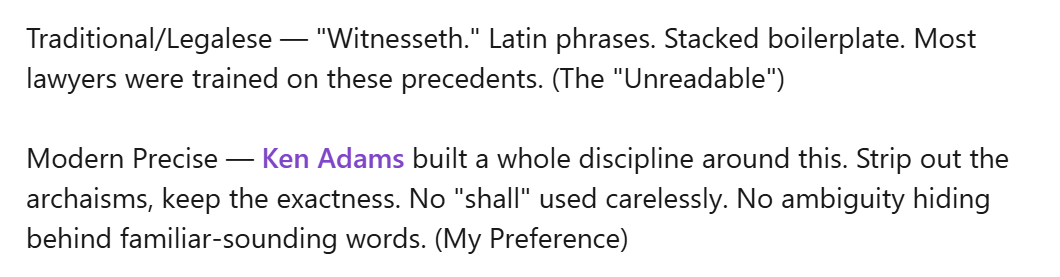
An extract from Jerry Levine's post about the six different styles of contract

Some Thoughts on the “Modern Precise” Style of Contract Drafting

Recently I saw this LinkedIn post by Jerry Levine in which he outlines six different styles of contract. The accompanying image is of how his post describes the first two kinds of contract, namely “Traditional/Legalese” and “Modern Precise.” He tags me in “Modern Precise,” saying I “built a whole discipline around this.” Jerry’s post got me thinking. In effect, he … Read More

Why Be a Critic?

In my article Merger Agreements Are Poorly Drafted, published today in Corporate Counsel Now (go here for the article, go here for the related blog post), I discuss the implications of an analysis I did of drafting shortcomings in the merger agreement for one of the biggest deals of 2025. Although this analysis is my most ambitious yet, I’ve done … Read More

Does Contract-Drafting AI Present the Same Risks As Medical AI?

In this post, I consider the risks posed by medical AI, then consider how to structure contract-drafting AI. The Risks of Medical AI Let’s start with medical AI. If you want some gripping reading, check out this LinkedIn article, The Great Inversion: How Healthcare AI Stopped Helping Doctors and Started Replacing Them. It’s by a surgeon, John Ferguson. It describes … Read More

“Reliable”

Recently, I noticed that a contract made it a condition to delivering notice that it be sent by (among other options) “reliable overnight delivery service”. Let’s consider the implications of “reliable”. Imagine that the contract required Acme to notify Widgetco if any widgets exploded. A widget exploded, so Acme sent a notice by Reliable Courier, Inc., for delivery the next … Read More