I’ve long preached the benefits of clearer contracts: you save time, save money, and reduce your risk.
But I’ve now started talking about making contracts “better.” One reason for doing so is that, as I explain in this blog post, “clearer” is necessary, but it’s not sufficient: “clearer” doesn’t address what to say in a contract. (I’ve been known to cover the what-to-say part by saying contracts should be clear, concise, and relevant, but referring to “better contracts” is a simpler way of capturing that idea.)
“Better contracts” would encompass the much greater potential for wasting time, wasting money, and adding risk that comes with the what-to-say part. But another reason to focus on contracts that are better, rather than just clearer, is that doing so would allow us to address an additional and different kind of risk. That risk is cognitive impairment in addressing the what-to-say part of contracts.
I’ve previously used the term “cognitive debt,” but I’ve decided it isn’t clear enough. Here’s how I describe cognitive debt in this blog post:
What’s cognitive debt? This 2025 MIT study defines cognitive debt as “a condition in which repeated reliance on external systems like LLMs replaces the effortful cognitive processes required for independent thinking.” And here’s how a commentator expresses it: “Cognitive Debt is where you forgo the thinking in order just to get the answers, but have no real idea of why the answers are what they are.” Once you lose a faculty through cognitive debt, it might be a challenge for you to regain it. If you decline to develop it in favor of cognitive debt, you might never acquire it.
That’s what I now describe as cognitive impairment. Cognitive impairment results not only from looking to AI to supply all your answers, but also from the old-fashioned form of copy-and-pasting.
I first encountered cognitive impairment in a common reaction to the highly customizable templates I’ve developed. That reaction was, “Too many questions!”
I found it shocking, and still do. The questionnaire a user is invited to complete covers a comprehensive decision tree, one vastly greater than whatever options (if any) are on offer in something you copy-and-paste from. If you need a contract for a transaction you don’t care much about, fine—don’t use a highly customizable template! But it you do care about the deal, it would be reckless for you to reject the opportunity to select optimal deal terms.
You’re uncertain how to answer some of the questions? Read the guidance. Still unsure? Ask AI. Or ask a human. Use it as an opportunity to learn.
Don’t want to have to keep answering questions every time you want to create a new contract? You don’t have to: you can recover a previous answer set and use that.
I discuss the too-many-questions issue in this 2023 blog post. I mention it again because it’s analogous to the AI-related version that has been recounted to me several times: instead of wanting choices, it seems many of us do in fact want AI to give us all the answers, so humans can be reduced to passive humans-in-the-loop. (In this case, “us” likely includes those who work with contracts and those calling the shots—the bean-counters, or administrators, or whatever you want to call them.)
Because you risk treating every deal like a cookie-cutter deal, that attitude is conducive to suboptimal deal outcomes. And it’s conducive to terminal career outcomes.
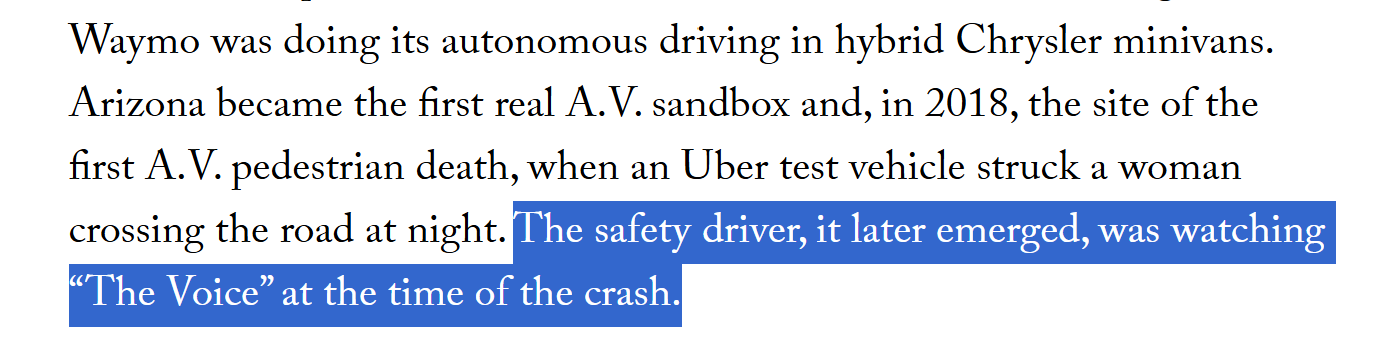
So referring to better contracts is my way of reminding myself that we would all benefit from contracts that are not only clearer and more concise but also more relevant, with a human getting to choose which options best suit the deal (with appropriate language being supplied as a commodity), instead of being reduced to a human in the loop, likely asleep at the wheel. (Speaking of which, the associated image is from a New Yorker article about Waymo. The highlighted text offers a great example of how the human in the loop is prone to tuning out.)