
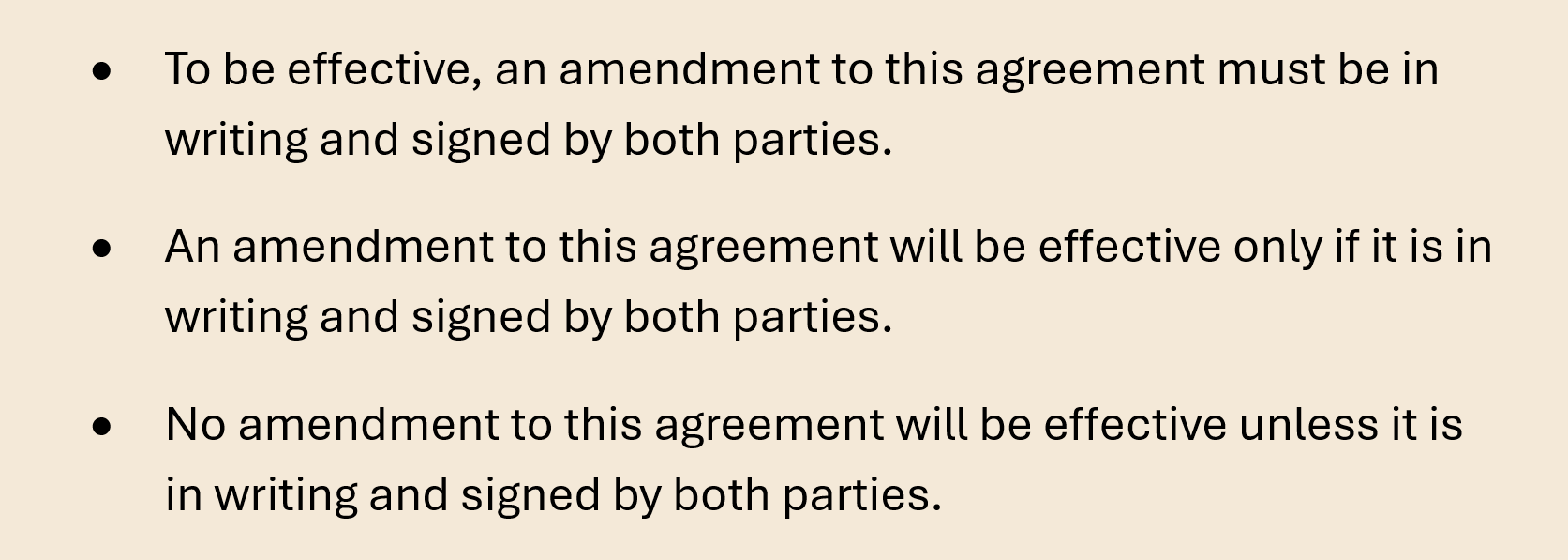
I’ve been presented with a choice between three alternative versions of a boilerplate provision. They’re shown in the image above.
Using my categories-of-contract-language lingo, the first version uses language of obligation to express a condition.
The second expresses a condition by using a conditional clause; because it uses the subordinator “if”, it focuses on the positive. It includes “only”—without it, the reader might infer that oral amendments too are effective.
Like the second version, the third expresses a condition by using a conditional clause, but because it uses the subordinator “unless”, it focuses on the negative.
All three say the same thing, and all are equally economical. I’m going with the first version. For one thing, it tells you up-front what’s at stake, whereas the other two make you wait until the middle of the sentence. And the third version focuses on the negative, making it just a bit harder to digest.
Each version allows for the possibility that effectiveness might be subject to another condition. For example, the amendment probably won’t be effective if one of the persons signing was eight years old.
(This post started as this LinkedIn post. If you’d like to know more about my “categories of contract language” framework, go here to get my “quick reference” chart.)