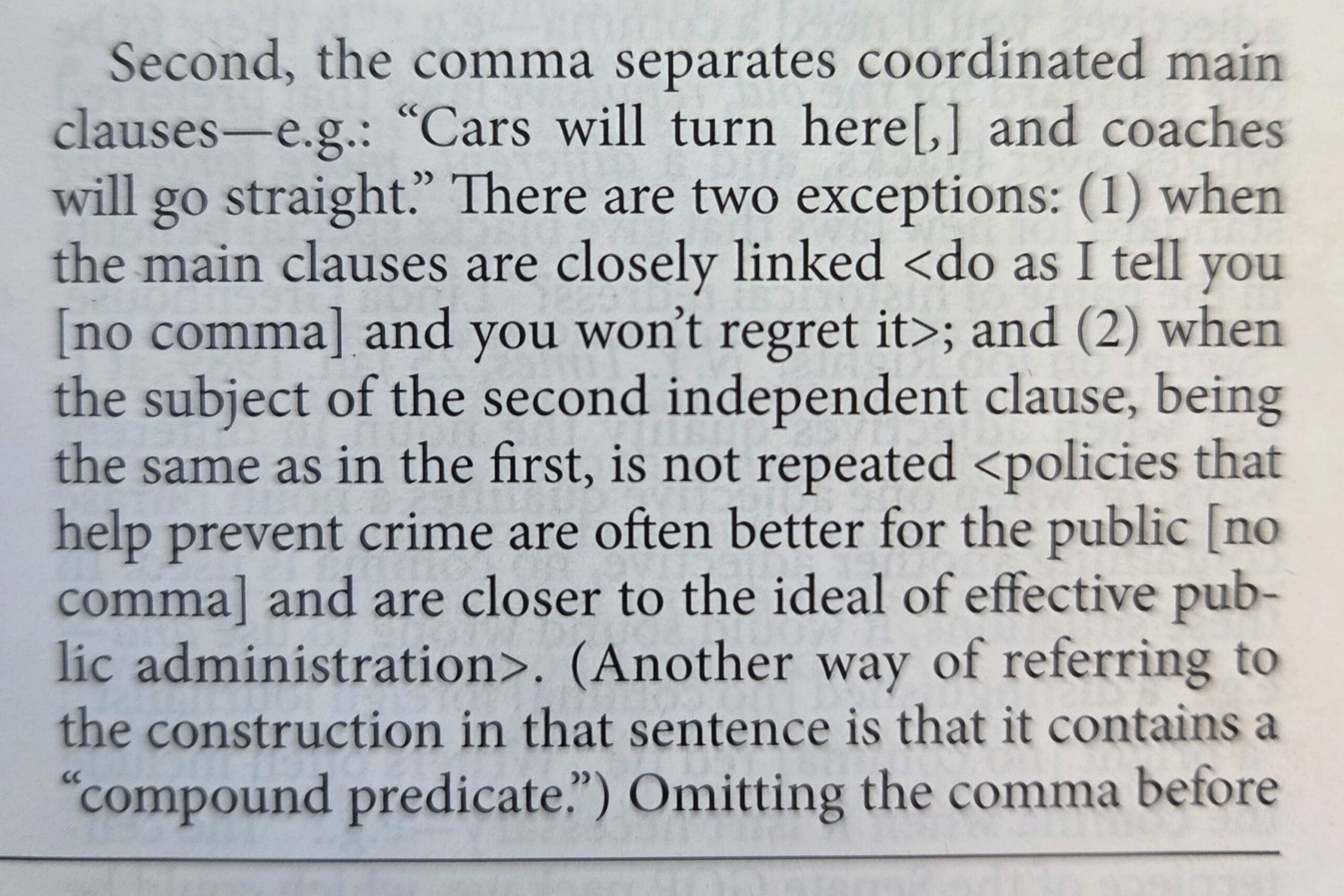
The first guide to English usage I turn to is Garner’s Modern English Usage. This post is about two mistakes I encountered in the past few days on reading the entry for “Punctuation.” More specifically, “D. Comma.”
The First Mistake
I captured the first mistake in the accompanying image, which is from page 897. This extract says that a comma is used to separate coordinated main clauses. It then offers two exceptions. But the second exception isn’t in fact an exception, because it doesn’t involve coordinated main clauses. Instead, it features predicates that share the same subject and are joined within a single independent clause. So it’s an example of coordination of predicates, not coordination of main clauses.
The Second Mistake
The second mistake involves overlap between two items on page 898. Here’s the first item:
Seventh, the comma separates a participial phrase, a verbless phrase, or a vocative—e.g.: “Having had breakfast[,] I went for a walk.”/ “The sermon over [or being over], the congregation filed out.”/ “Fellow priests[,] the clergy must unite in reforming the system of electing bishops.”
Here’s the second item:
Ninth, there is the vocative comma, which sets off a name, word, or phrase used as a term of address <Alexandra, you’re so adorable!> <honey, I’m home!> <listen, you jerk, I’ll be back!>.
So both entries cover the vocative comma. The first covers it partially, with other uses of the comma; the second covers it more comprehensively. I assume it would have made sense to eliminate it from the first item.
Why I Point Them Out
Mistakes in a reference work matter: if the author thought it worth addressing something, then presumably it would have been worth getting it right.
I mention these mistakes because they’re not trivial. Because finding two such mistakes in consecutive pages covering a given topic is disconcerting. And because I encounter mistakes sporadically in Bryan Garner’s work.
When Garner writes about contract language, I scrutinize what he has to say. I even did this review of his 2019 book on the subject. But I approach Garner’s Modern English Usage as a regular reader. I’d rather I not find mistakes. And I don’t make it a point of cataloguing the mistakes I do find. But I find them often enough that I’m now on the lookout for them. Finding these two was a tipping point, hence this post.
(Needless to say, if you see mistakes in my work, please let me know! You’ll find me grateful.)