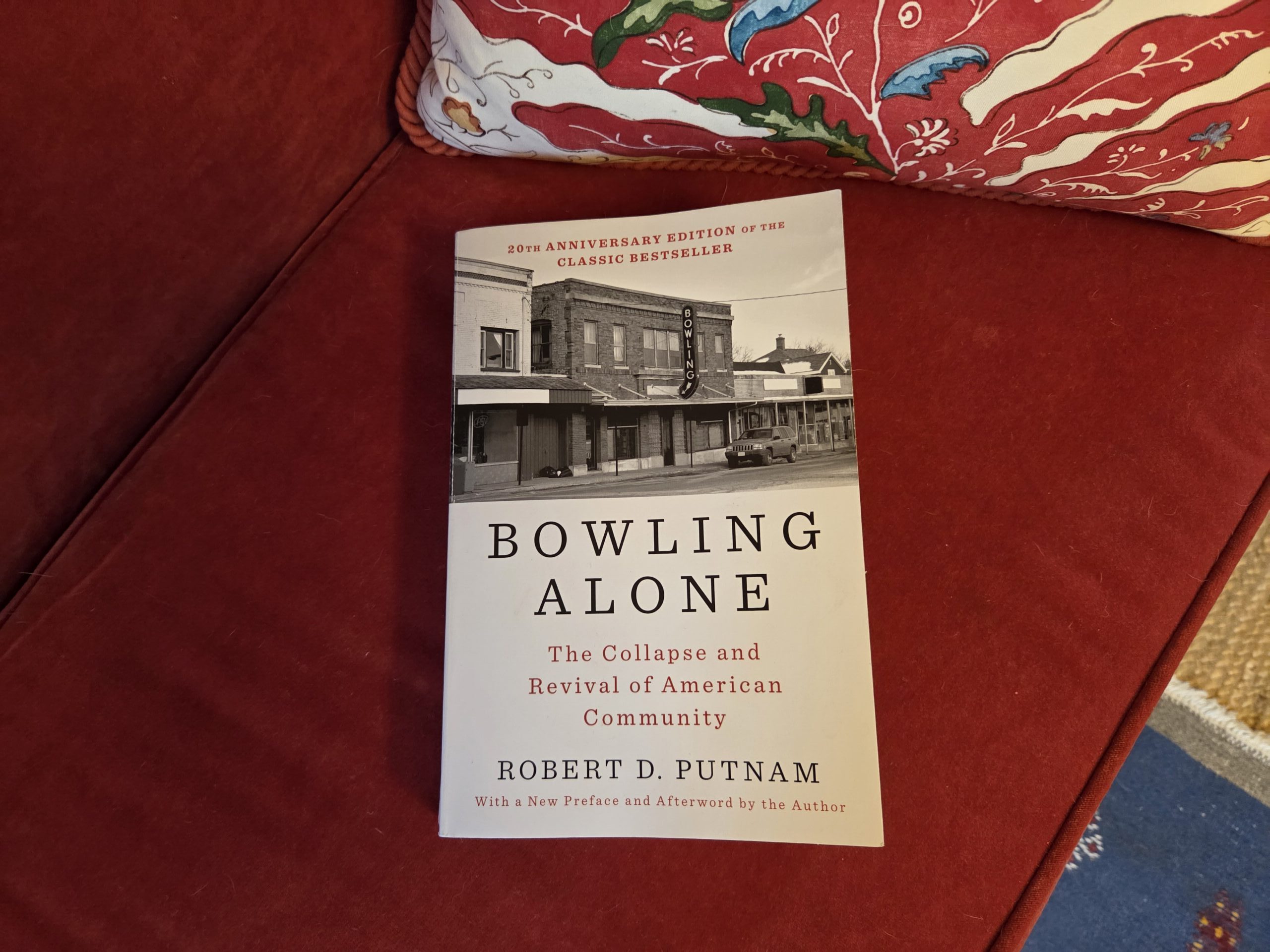
I’ve been reading Robert D. Putnam, Bowling Alone: The Collapse and Revival of American Community (2000, rev. ed. 2020). It’s about how Americans have become increasingly disconnected from one another and how our social structures have disintegrated. (Yeah, it’s that upbeat.) Surprisingly, it has something to say about contracts.
Generalized Reciprocity
Chapter 8 (Reciprocity, Honesty, and Trust) is about generalized reciprocity. It appears in the Bible as “do unto others as you would have them do unto you,” but different religions, philosophies, and secular traditions have expressed the same notion, which is now known generally at “the Golden Rule.”
In a community that follows the principle of generalized reciprocity, looking out for others ends up being a form of self-interest. We can each let down our guard a little, and transaction costs are reduced.
Putnam distinguishes between “thick trust,” based on personal relations that are strong, frequent, and nested in wider networks, and “thin trust,” which comes into play in interactions with strangers or passing acquaintances. Putnam says, “Thin trust is even more useful than thick trust, because it extends the radius of the trust beyond the roster of people whom we can know personally.”
Here’s what Putnam says has happened to thin trust:
In the mid-196s, however, this [growth in social trust] was reversed, initiating a long-term decline in social trust. … Every year, fewer and fewer of us aver that “most people can be trusted.” Every year more and more of us caution that “you can’t be too careful in dealing with people.” If generalized reciprocity and honesty are important social lubricants, Americans today are experiencing more friction in our lives than our parents and grandparents did a generation ago. [T]his decline in social trust has been even steeper among younger Americans than among the rest of us, especially since 1985.
Growth of the Legal Profession
Now, let’s consider the growth of the legal profession. Here’s what Putnam says:
[O]ne alternative to generalized reciprocity and socially embedded honesty is the rule of law—formal contracts, courts, litigation, adjudication, and enforcement by the state. Thus, if the lubricant of thin trust is evaporating from American society, we might expect to find greater reliance on law as the basis for cooperation. If the handshake is no longer binding and reassuring, perhaps the notarized contract, the deposition, and the subpoena will work almost as well. One way to explore this hypothesis is to examine our changing national investment in the legal system
…
Astonishingly, America had fewer lawyers per capita in 1970 than in 1900. … After 1970, however, the ratio of lawyers to the rest of us suddenly exploded, more than doubling in the next quarter century and bloating this entry in our national “transaction costs” accounts.
…
Moreover, the massive expansion of the legal profession was not simply part of the growth of all professions, for no other major profession experienced this same post-1970 explosion. After 1970 the legal profession grew three times faster than the professions as a whole.
After considering some explanations for this explosive growth, here’s how Putnam concludes the chapter:
In fact, the largest increase on the demand side for legal work seems to have been in what is gently termed “preventive lawyering.” Throughout the American society and economy, beginning around 1970, informal understandings no longer seemed adequate or prudent. The suddenness of the change and its timing seem uncannily similar to trends in other measure of social capital that we have examined. Spouses, neighbors, business partners and would-be partners, parents and children, pastors and parishioners, donors and recipients—all of us abruptly began to demand to “get it in writing.” …
…
Almost imperceptibly the treasure that we spend on getting it in writing has steadily expanded since 1970, as has the amount that we spend on getting lawyers to anticipate and manage our disputes. In some respects, this development may be one of the most revealing indicators of the fraying of our social fabric. For better or worse, we rely increasingly—we are forced to rely increasingly—on formal institutions, and above all the law, to accomplish what we used to accomplish through informal networks reinforced by generalized reciprocity—that is, through social capital.
What’s Lost in Relying More on Contracts
It’s worth considering the nature of the transaction costs incurred in relying increasingly on contracts to accomplish what used to be accomplished through social capital.
I recall somewhere in my reading encountering a passage in which the writer discussed asking a child to instruct the writer to make a peanut-butter-and-jelly sandwich. With each instruction offered by the child, the writer took advantage of any imprecision to fail to produce the sort of sandwich one would expect.
That exercise demonstrates why, in an environment devoid of social trust, people will be inclined to express their demands in lengthy and relatively inflexible detail. With that sort of precision, you pile on the transaction costs. By contrast, with social trust and a handshake comes flexibility.
Furthermore, when considering transaction costs, you have to consider that contracts have always been artisanal. Since forever, we’ve drafted contracts by copy-and-pasting, on faith, from precedent contracts and templates of questionable quality and relevance. That’s still the case, even though handling contracts has become a sprawling industry. A veneer of technology won’t fix the original sin of contracts—copy-and-paste dysfunction. Contracts work is awash in futility, and I have yet to see in those making the decisions sufficient interest in making contracts better. And there are two related problems to consider: how contract drafting is taught at law schools is inadequate, and too many judges are bad at textual interpretation.
So in saying in the second quotation block above, “If the handshake is no longer binding and reassuring, perhaps the notarized contract … will work almost as well,” Putnam was too generous.