
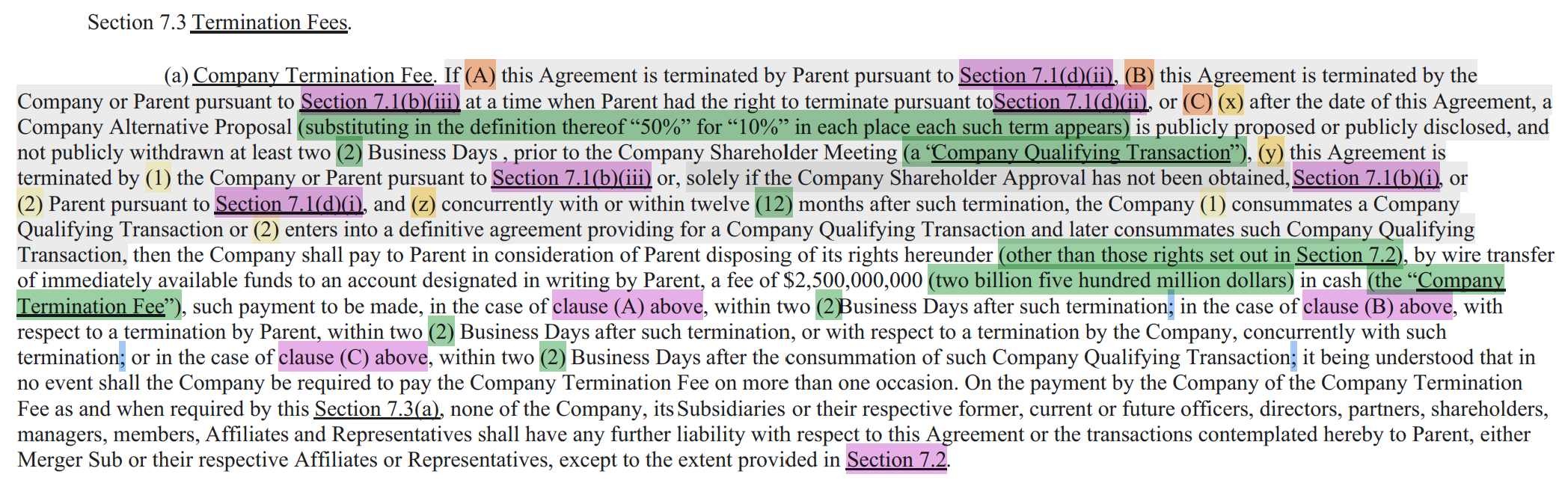
This image is from a public-company merger agreement. I highlighted those components that complexify contracts. Different levels of enumerated clauses. Cross-references. Parentheticals. Exceptions. Conditions. I think “the sprawl” is a suitable term for this sort of contracts complexification. (I’m not suggesting that this example is anything exceptional.)
“Complexification” is a neutral term—complexity doesn’t have to be inherently bad. But adding complexification makes a contract progressively harder to wade through.
I assume that much of the complexification on display in this subsection, and in the sprawl generally, is the result of negotiations, instead of being built into templates. Two factors might be relevant. First, endless copy-and-pasting and a wealth of bogus conventional wisdom have together done a number on our cognition. And second, lawyers are prone to indulging in negotiation theater—using negotiation as an opportunity to demonstrate their value and their acumen. So in a given set of redlines, you can expect some portion to be counterproductive. (I say this as an interested bystander: I haven’t done deals in more than 20 years.)
Perhaps there are three things one can do about this.
First, try to know what you’re talking about. I’ve found boilerplate to be a good starting point. It’s easy for your eyes to glaze over when you’re presented with boilerplate, but boilerplate matters. Stuff is, or might be, at stake, the issues can be subtle, and you’re required to make decisions. You might find helpful this hyperlinked list of my writings on boilerplate. Yes, getting to grips with boilerplate requires that you read and think. And you’re at risk of learning something. But without reading, thinking, and learning, you’re likely not going anywhere interesting.
Second, accept the at some point in your complexification, the cost you add might well outstrip the benefits. Check out Alex Hamilton’s book Sign Here: The Enterprise Guide to Closing Contracts Quickly.
And third, adding change into a process never helps the process. Instead of making changes upon changes, it would be much more efficient to decide, then draft. A good way to do that would be by using a negotiation platform. A simple way to accomplish that would be to have the parties complete together the interview for a highly customizable automated contract template.
To put you in a suitable frame of mind, here’s “Sprawl I (Flatland),” by Arcade Fire.