
Friends, today is a special day, as I’m able to introduce to you a new kind of syntactic ambiguity. (A Manual of Style for Contract Drafting says, “Syntactic ambiguity arises principally out of the order in which words and phrases appear and how they relate to each other grammatically.” But here’s my updated version: “Syntactic ambiguity arises when you have a modifier before or after a series of two or more nouns or other components. The question is whether the modifier applies to all the components, whether upstream or downstream, or just to the component next to the modifier.”)
Well, this form of syntactic ambiguity is new to me, at least, and I haven’t seen it discussed anywhere.
Consider this sentence:
The rights of all parties hereto shall be subject to the jurisdiction of and be construed according to the laws of the State of Florida, with venue in Collier County, Florida.
It’s the sentence at issue in a recent Florida appellate decision, Treasure Coast Classical Academy, Inc. v. Optima Foundation, Inc. But this post has nothing to do with what that fight was about. (My analysis of that will appear soon enough.)
Instead, what’s of interest is the part before the comma: The rights of all parties hereto shall be subject to the jurisdiction of and be construed according to the laws of the State of Florida. It exhibits the linguistics phenomenon know as “right node raising.” But this instance of right node raising features a defect.
First, what is right node raising? It’s described in the screenshot below from Sabbagh, Joseph. 2014. “Right Node Raising,” Language and Linguistics Compass 8:
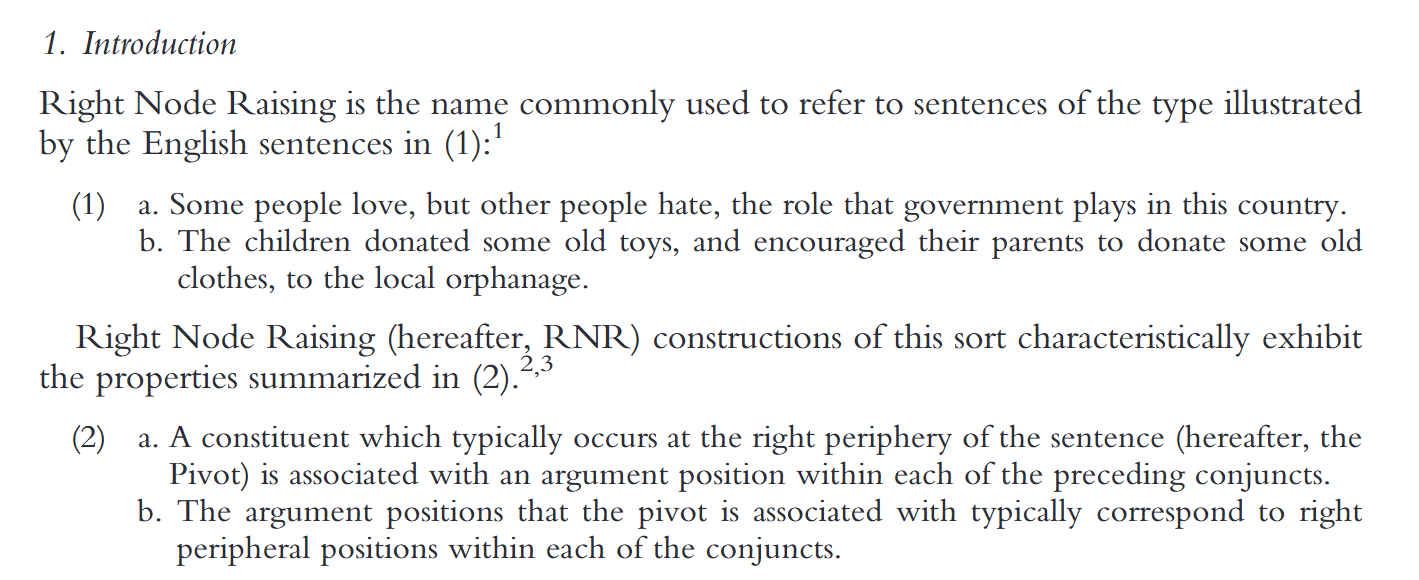
Now we get to the defect exhibited by the first part of the sentence at issue in Treasure Coast.
I discussed this sentence with John Coyle, who is The Man when it comes to how contracts address governing law, venue, and jurisdiction. In the draft I was working on at the time, I proposed that right node raising operated on the first part of the sentence such that it expresses the following meaning: The rights of all parties hereto shall be subject to the jurisdiction of the laws of the State of Florida and be construed according to the laws of the State of Florida.
John commented, “I don’t think this is the best way to read the provision. The phrase ‘the laws of’ only applies to the second half. It doesn’t apply to the first half.”
Me? Mind. Blown. Here it is, the new kind of syntactic ambiguity. Let’s call it “right-node-raising pivot ambiguity.” The first part of the sentence can be read in two ways: the pivot could be either the laws of the State of Florida (as I originally proposed) or the State of Florida (as John suggested).
I won’t discuss here the implications of that ambiguity, but it’s not significant. What’s more important is that I’m now aware that that kind of ambiguity exists at all!
What’s the defect that gave rise to the ambiguity? The drafter neglected to use a comma to demarcate the end of each argument position (to use Sabbagh’s term). Commas aren’t optional: They feature in every example in Sabbagh’s paper, and his paper otherwise doesn’t consider the role of commas.
So whoever drafted the language at issue in Treasure Coast would have done well to include commas in the first part of the sentence, one after jurisdiction of, the other after according to or, more likely, the laws of, as John suggested.
In this 2021 blog post, I discuss use of commas in right node raising, but I call them “delimiting commas in coordination.” Now that I’m hip to the linguistics lingo, I’ll call them “offsetting commas in right node raising,” and I’ll revise that blog post and, in due course, MSCD accordingly.
That, friends, is an example of my version of making things better. I’d have gotten nowhere without that mentality. When it comes to contract language, our industry seems to have largely forgotten about making things better. We should get reacquainted with it.
Updated 15 August 2026: The ambiguity discussed above isn’t significant, but that’s just a function of that example. Here’s an example of right-node-raising pivot ambiguity I invented where more is at stake:
On occurrence of a Qualifying Event, at Acme’s election either Widgetco shall refurbish [,] or Acme may dispose of [,] no more than 20% of [,] all Widgets.
With the offsetting commas, you have two choices of where to put the second comma: the pivot is either no more than 20% of all Widgets or just all Widgets. Without commas, it’s not clear which of the alternative meanings applies, so you have the potential for a fight.
As terminology, “right-node-raising pivot ambiguity” might seem a little silly. But the only way to make a new phenomenon accessible is to give it a name. So I’ve not been shy about inventing terminology. In this case, I had no choice but to come up with a term that describes the ambiguity.