
[Updated 2:30 p.m. ET to incorporate Vance’s version (see his comment).]
Below are five versions of a sentence, with the only difference being the order in which the components are arranged.
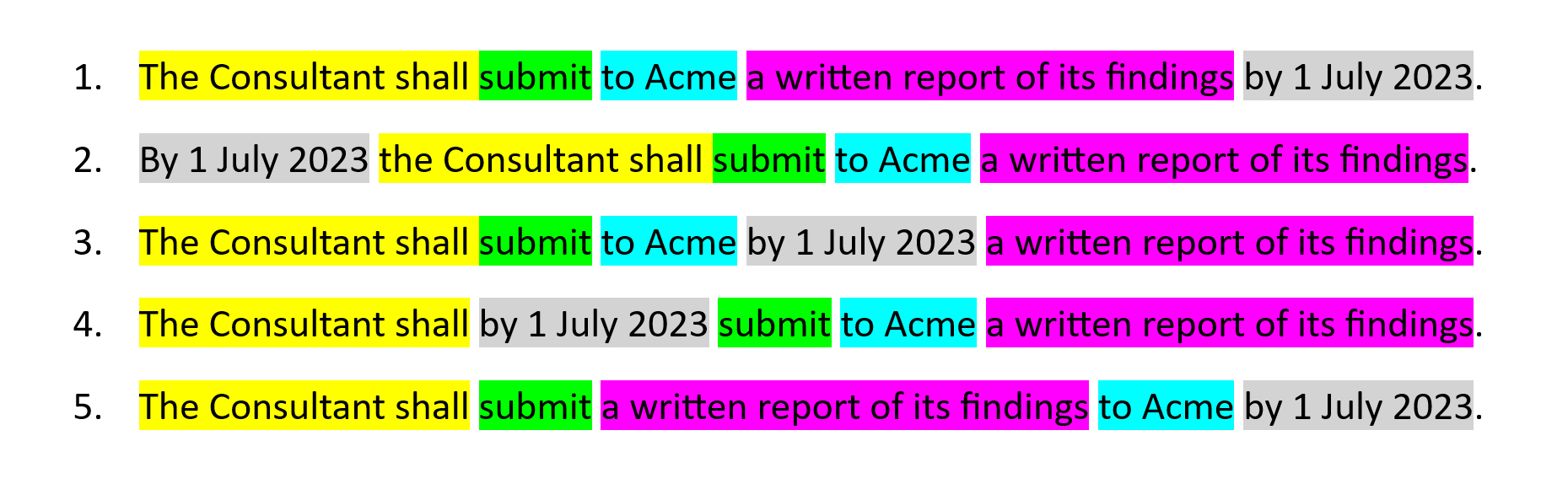
I listed the first four in the order in which I preferred them at the time of posting, from most preferred to least. The fifth is the version proposed by Vance in his comment to this post.
Regarding Vance’s version, the longer the direct object (in this case, a written report of its findings), the more inclined I am to put it after the indirect object (in this case, Acme), one reason being that the indirect object tends to get embroiled in syntactic ambiguity. (I’m afraid I don’t have the time to research the linguistics of this.)
The point of this post is just to remind myself that how to order the parts is just one more issue to consider in writing contracts or anything else.