
Antecedent ambiguity is a distinct kind of ambiguity. As MSCD says, “Confusion can arise if it’s not clear what the antecedent is of a given element.” MSCD offers as an example of antecedent ambiguity John read Bill’s email, and he is furious. The antecedent of he could be either John or Bill.
Today I found another instances of antecedent ambiguity. I found it because I wrote it in an email. Here it is:
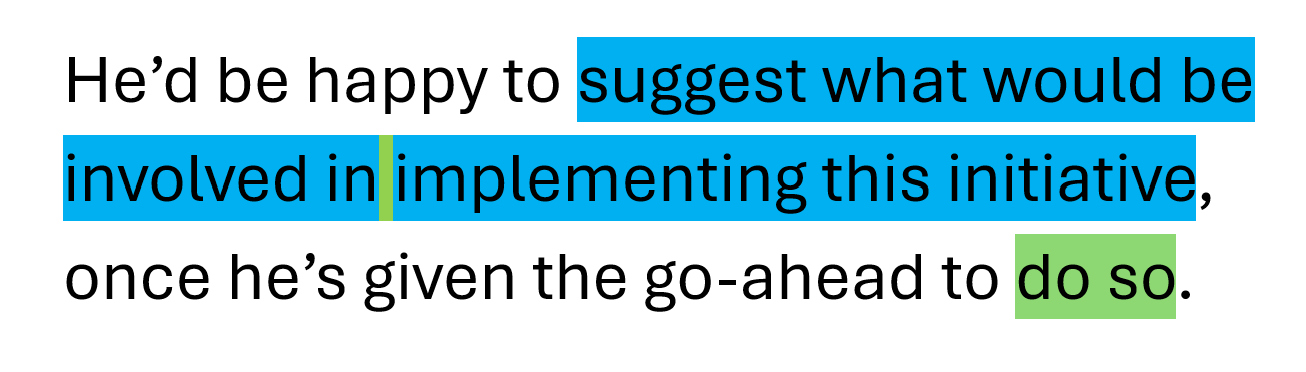
In this case, what is in need of an antecedent? In other words, what’s the anaphor? The anaphor is do so. What’s the antecedent of do so? It’s either what’s in the blue highlighting to the right of the light-green strip (implementing this initiative) or everything highlighted in blue (suggest what would be involved in implementing this initiative).
I bring this example to your attention because it’s very different from the MSCD example. In the MSCD example, the anaphor is a pronoun; the antecedents are two competing noun-phrases. In the above example, the anaphor is a verb-phrase pro-form, in other words an expression that replaces one of the two nested verb phrases. Same phenomenon, different category of anaphora, different kind of verb structures. Spotting one doesn’t mean you’re equipped to spot the other.
MSCD offers an example of litigation caused by antecedent ambiguity. I’d be interested to know of others.
(Do you have a comment you’re itching to unleash on the world? Consider posting it on this blog. I’ve reinstalled Disqus to make that a more appealing prospect.)