
Last week I tweeted this image:

In the tweet, I said this:
There’s a disconnect in meaning between the definition (green) and the defined term (red). The way to fix it is by “clarifying the scope” of the definition: adding a phrase-plus-comma at the beginning of the defined-term parenthetical. Any suggestions?
In a reply, I offered this fix, while acknowledging that it would probably be best to start over: (any such signed document, a “Change Order”).
My original tweet prompted this response from @PlaybookLegal (a troll), in this tweet:
This kind of question is so academic…I want to say, this simply does not matter…as lawyers, we should try to avoid spending time on getting 100% perfect linguistical drafting and focus on issues that actually matter. Is this ever going to get litigated? Is there confusion?
In this post, I’ll try to explain myself. Let’s start with what the manuscript of the fifth edition of A Manual of Style for Contract Drafting says about clarifying the scope:

So I’m not suggesting you have to clarify the scope. You do it only if it would make the reader’s life easier. Consider this example:
 The defined-term parenthetical (at the end of the sentence) is sufficiently far from the key noun, contractor, that I think the reader would benefit from being reminded how far back up the sentence the definition begins. But clarifying the scope would be more important if the defined term didn’t include the word contractor. Ultimately, it’s a judgment call. I’m inclined to err on the side of clarifying the scope, but at the cost of only a few words in exchange for greater clarity.
Is there confusion? In this case, no. But figuring out how to say in a contract whatever you want to say isn’t just about avoiding fights. It’s also about making it easy for the reader to understand what you’re saying. If you focus only on avoiding confusion, that’s a low bar.
Here’s another example:
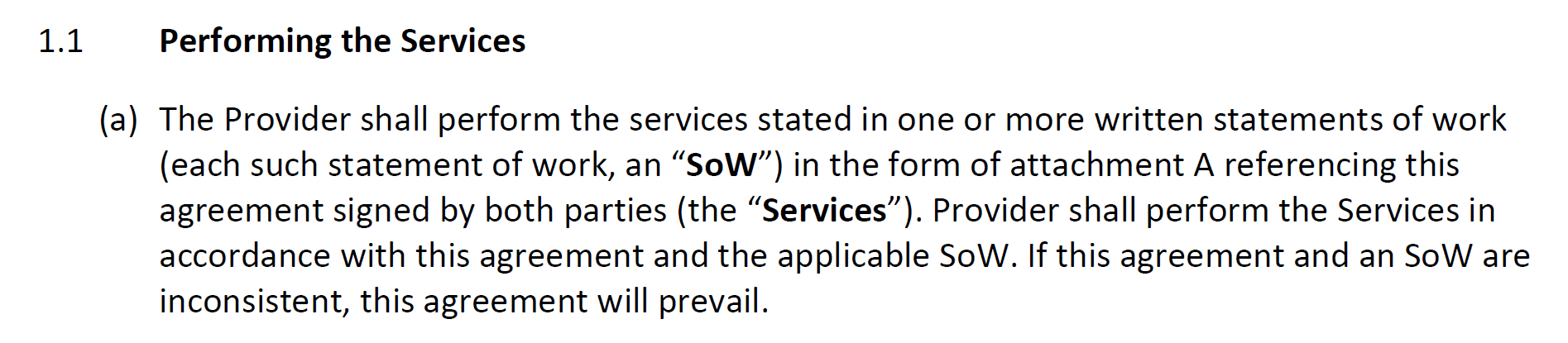
I’d be inclined to clarify the scope by adding at the beginning of the Services defined-term parenthetical the services specified in an SoW, plus a comma. That would make it clear that the services aren’t simply services aimed at designed widgets, or whatever. Instead, they’re the services described in a statement of work.
If you don’t clarify the scope in that example, might the parties get into a fight over what Services means? Well, I’ve seen weirder fights.