Longtime reader Frank Chmielewski thought I might find of interest something in one of the subscriber emails sent out by author, entrepreneur, and teacher Seth Godin. Frank sent me a screenshot. Here it is:
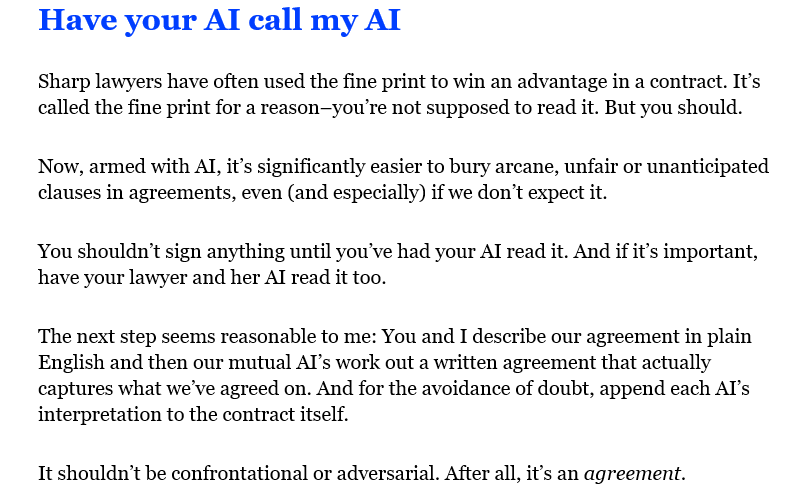
In the first paragraph, Seth invokes the archetype of the sneaky lawyer. Sneaky lawyers doubtless exist, but more in our imagination than in reality.
For one thing, being sneaky isn’t conducive to harmonious contract relations. Furthermore, being sneaky connotes some level of mastery, but nothing about mainstream contract language suggests mastery. Instead, it’s dysfunctional.
Since forever, we’ve drafted contracts by copy-and-pasting from precedent contracts and templates of questionable quality and relevance. That’s what we’ve been instructed to do, and it’s been our only option. So generally, we don’t entirely understand why contracts say what they say, and we’re unaware of flaws in how they say it. Thanks to the copy-and-paste machine, mainstream contract drafting consists of smart people churning out suboptimal contracts.
I’ve devoted my career to chronicling the dysfunction of mainstream contract language. See for example my 2026 article Merger Agreements Are Poorly Drafted, which is about my analysis of extracts of the merger agreement for one of the biggest deals of 2025.
In the second paragraph of his email, Seth refers to AI being used to hide stuff in contracts. That seems unlikely: “Claude, please make particularly hard to read and understand those provisions that disadvantage the buyer.” Lawyers don’t need help making contract language obscure: for centuries, they’ve been doing that all on their own.
Then there’s Seth’s proposal. It would result in four versions of a contract: the legalistic version, the plain-English version, and two AI versions, one created by each party. That invites confusion.
I have a simpler idea: instead of remaining mired in dysfunction, let’s fix contracts. Yes, it would require building a library of highly customizable templates, but that wouldn’t require too much in the way of time and resources. If we had started on that when I began agitating for it, we would have long ago done the bulk of the work. But the next best time to get started on it is now. (My recent attempt, with Adams Contracts, represents a decent start, but it lacked resources and marketing muscle.)
(If Seth tells me he disapproves of my using the screenshot, I’ll delete it.)