Blog

Now Launched: “Drafting Clearer Contracts: On Demand”

The next piece in my Drafting Clearer Contracts, uh, empire is Drafting Clearer Contracts: On Demand. It’s now live: go here. Currently, it consists of 45 videos and four multiple-choice quizzes. On 1 May 2026 and on the beginning of each subsequent month, I’ll make available a further 25 or so videos and who knows how many quizzes. Once the … Read More

Revisiting “In All Material Respects”

From my perspective as someone trying to figure out how to make contract language clearer, a welcome development in Delaware caselaw was what the Delaware Court of Chancery had to say about the phrase in all material respects. The case is Akorn, Inc. v. Fresenius Kabi AG, No. CV 2018-0300-JTL, 2018 WL 4719347, at *85 (Del. Ch. 1 Oct. 2018), aff’d, … Read More

No Ampersands in Contracts!

I noticed that MSCD doesn’t contain the word ampersand. With this post, I aim to set that right for the sixth edition! As Wikipedia tells us, “The ampersand, also known as the and sign, is the logogram &, representing the conjunction ‘and’. It originated as a ligature of the word et (Latin for ‘and’).” I suggest that the only ampersands … Read More

More Front-of-the-Contract Excitement!

The image above consists of the introductory clause from a form of merger agreement I encountered online. It’s interesting in two respects. First, it doesn’t say “This Agreement and Plan of Merger is dated … and is between”. Instead, by saying “This is an Agreement and Plan of Merger”, it puts the verb up front. That’s unhelpful, because it has … Read More

“Reliable”

Recently, I noticed that a contract made it a condition to delivering notice that it be sent by (among other options) “reliable overnight delivery service”. Let’s consider the implications of “reliable”. Imagine that the contract required Acme to notify Widgetco if any widgets exploded. A widget exploded, so Acme sent a notice by Reliable Courier, Inc., for delivery the next … Read More

Reverse Autonomous Definitions?

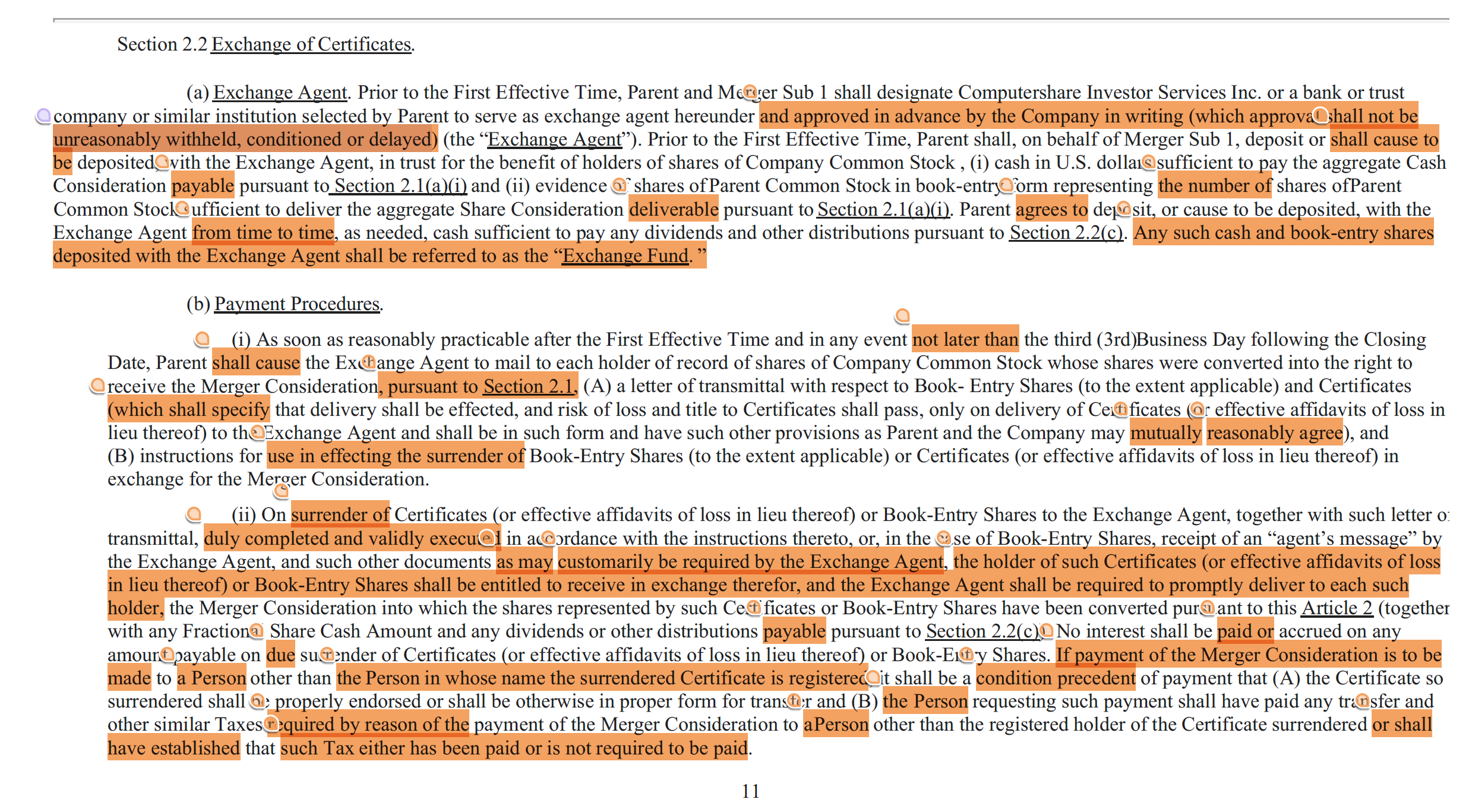
Check out the following, which is the text of an entire section: See the highlighted sentence at the end? It reminded me of that there’s another way of creating defined terms using autonomous definitions. At least for now, I’m calling this technique a “reverse autonomous definition.” Allow me to demonstrate how it plays out. Here’s an autonomous definition: “Affiliate” means … Read More

M&A Drafting: Double Materiality in the Bringdown Condition Is a Nonissue

I’ll now revisit something I last wrote about in 2013: double materiality in the bringdown condition. (I see the term “double materiality” thrown around in other contexts, so I think it’s best to be specific.) The Theory Here’s a statement of fact (in the language of the Ancient Ones, a “representation and warranty”) and the associated bringdown condition, neither qualified … Read More

“Battle-Tested” Contracts?

Longtime readers will be aware that I roll my eyes at the notion of relying on contract language that has been “tested” by courts. As I say in a 2006 blog post, “Why rely on language that resulted in litigation? Instead, express any given concept clearly, so you don’t have to gamble on case law breathing into it the desired … Read More

When “Greater or Lesser” Doesn’t Work

Here’s an instance of the phrase greater or lesser: Unobjectionable, right? Here’s another instance: Unobjectionable too, no? Here’s another example of the same sort: That’s unobjectionable too, right? Actually, the second and third examples don’t work. The first example refers to something getting bigger or smaller. So in that context, greater means “bigger” and lesser means “smaller”. By contrast, the … Read More