
Check out the following, which is the text of an entire section:
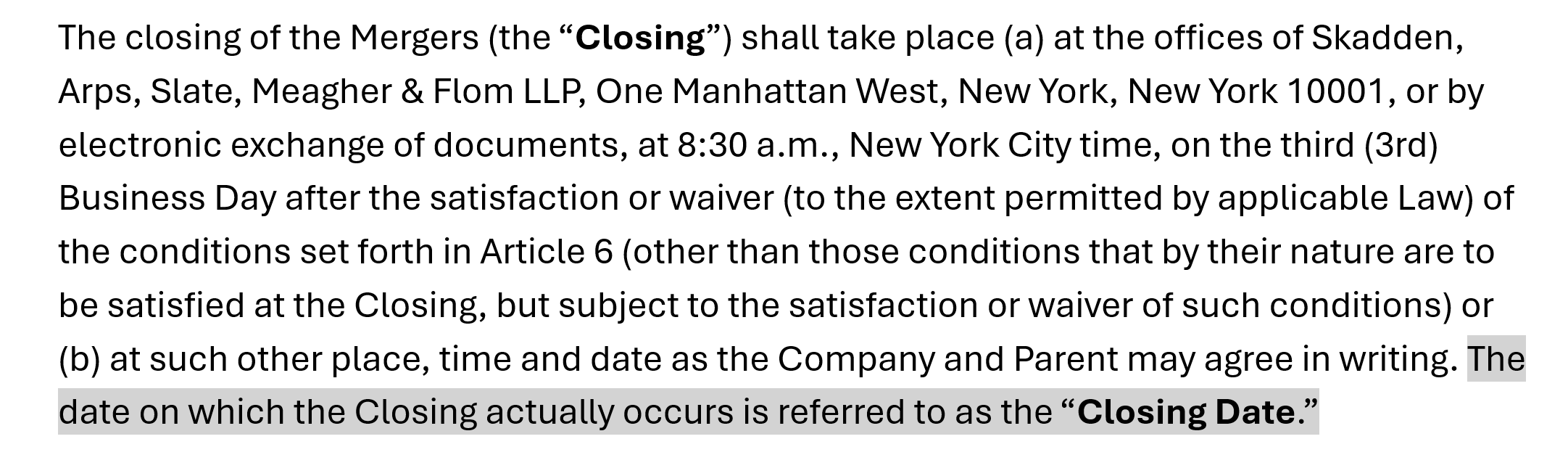
See the highlighted sentence at the end? It reminded me of that there’s another way of creating defined terms using autonomous definitions. At least for now, I’m calling this technique a “reverse autonomous definition.”
Allow me to demonstrate how it plays out. Here’s an autonomous definition:
“Affiliate” means any Person that, directly or indirectly through one or more intermediaries, controls or is controlled by or is under common control with a Person , as those terms are used in and construed under Rule 405 under the Securities Act.
Here’s a reverse version of that autonomous definition, with the term being defined stuck at the end:
Any Person that, directly or indirectly through one or more intermediaries, controls or is controlled by or is under common control with a Person, as those terms are used in and construed under Rule 405 under the Securities Act, is referred to as an “Affiliate.”
Here’s what I think of reverse autonomous definitions in general. First, they put at the end the most important information, namely the defined term that’s being created. Second, because means is shorter than is referred to as plus an article, if any, reverse autonomous definitions will always be a little longer—in the case of the above example, four words longer. And third, putting the period within the quotation marks is standard in the US, but I’d be inclined to put it after, because the period isn’t part of the defined term.
So I’m not keen on reverse autonomous definitions.
What to do instead? The Closing Date example shows that you have to take context into account when deciding how to create a defined term. The defined term Closing Date is used for the first time in the next section. Why stick an autonomous definition of Closing Date at the end of the previous section? MSCD says “Autonomous definitions placed on-site should follow, in a section, right after the provisions that use the terms being defined.” Not before.
So that leaves two alternatives. First, you could use an integrated definition while also clarifying the scope (that’s how I describe the function of the preliminary phrase in the defined-term parenthetical):
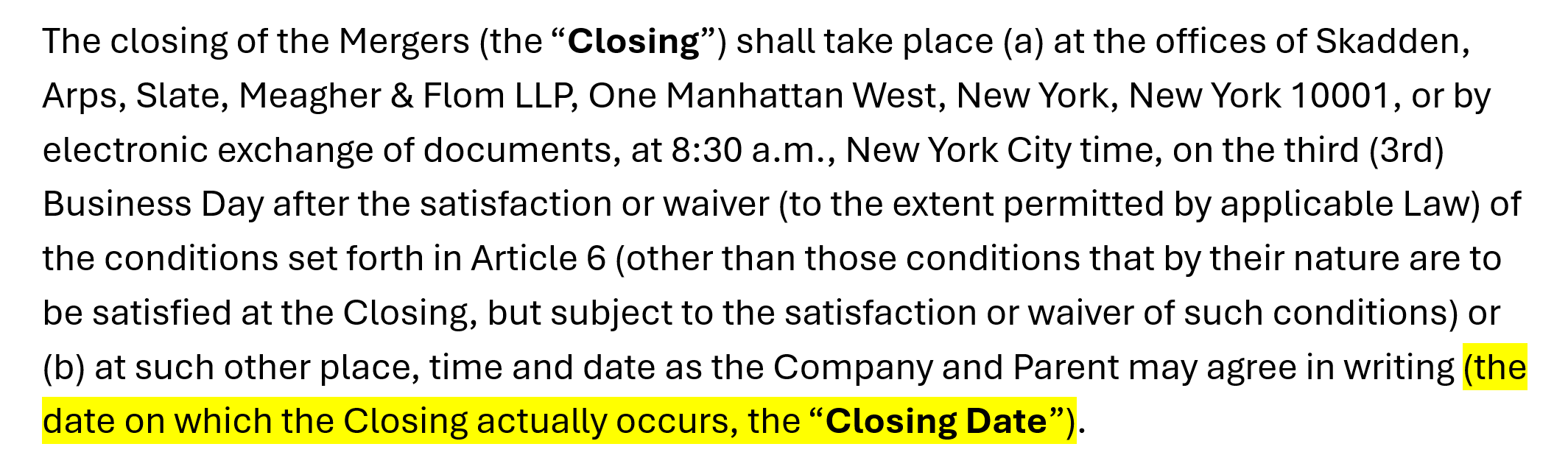
But using an integrated definition here is inconsistent with how integrated definitions work, as the definition is in effect entirely within the defined-term parenthetical.
Or second, you could define Closing Date in the next section, where Closing Date is used for the first time. I think that’s what I’d do, using an integrated definition:

So all told, I’m happy to have belatedly considered reverse autonomous definitions, but I recommend you not use them.