
Thanks to tipster Glenn West, I learned of an opinion of the U.S. Court of Appeals for the Federal Circuit: Netflix, Inc. v. DivX, LLC, No. 2024-1541, 2026 WL 405791, at *1 (Fed. Cir. 13 Feb. 2026).
It involves a patent dispute. Here’s the language at issue, from claim 1 of the patent:
locating encryption information that identifies encrypted portions of frames of video within the requested portions of the selected stream of protected video;
It exhibits syntactic ambiguity. Here’s how the court describes it:
One thing is plain about this language, considered on its own (before considering background interpretive principles, other claim elements, and the specification): the language is susceptible of two different interpretations, each syntactically and semantically available. Considering the phrase on its own, the modifier “within the requested portions of the selected stream of protected video” could modify either “encrypted portions of frames of video” or “encryption information,” i.e., could specify the location of either the encrypted portions or the encryption information. Syntactically, a modifier with two distinct possible modificands is susceptible of modifying either one. And semantically, in the present example, considering the phrase on its own (indeed, even in broader context), neither of the possibilities can be excluded as obviously senseless or implausible.
Here’s how the court went about resolving the dispute:
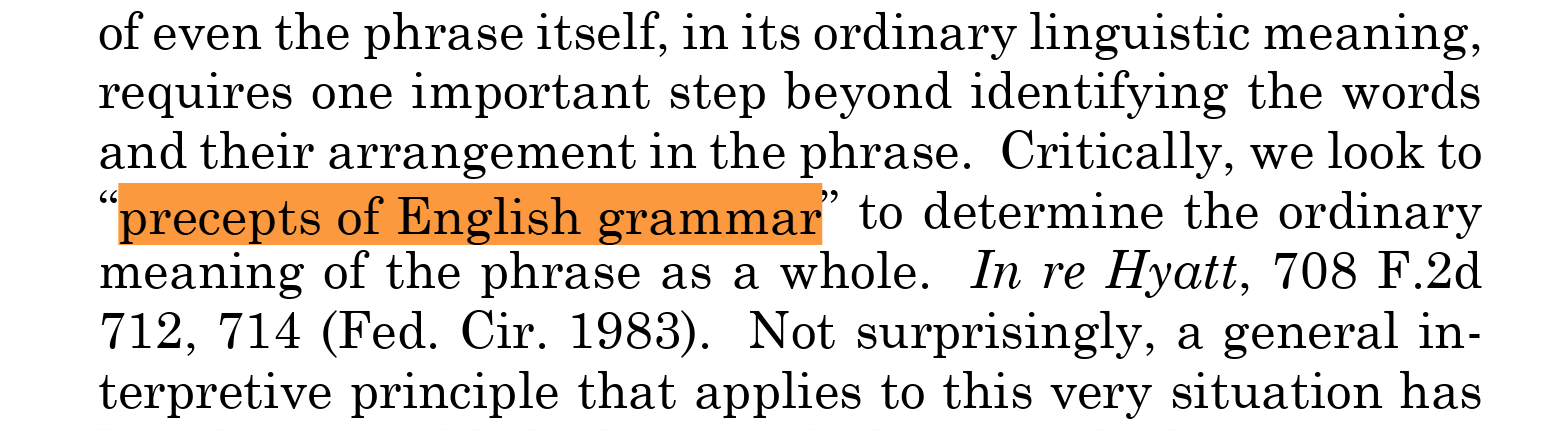
Critically, we look to “precepts of English grammar” to determine the ordinary meaning of the phrase as a whole. [Citation omitted.] Not surprisingly, a general interpretive principle that applies to this very situation has long been established, precisely because the linguistic situation occurs frequently and therefore a default principle is needed.
The principle is that (where commas or other textual signals are not used) the modifier is presumptively understood to be tied to the nearest available semantically plausible modificand.
But the principle the court cites is not a “precept of English grammar.” Instead, it’s a “canon of construction”—a pompous term for a principle of interpretation made up by courts to facilitate resolving disputes over ambiguous text. Presumably it offers better optics than “an arbitrary rule applied when all else fails.”
The court says the principle it invokes “also appears in normative guides to writing, which reflect (and reinforce) how language is most likely to be understood.” In support of that, the court cites § 5.175 of the 16th edition of The Chicago Manual of Style. Here’s what the current edition—the 18th—says in what I assume is the relevant section, namely § 5.184:
A prepositional phrase with an adverbial or adjectival function should be as close as possible to the word it modifies to avoid awkwardness, ambiguity, or unintended meanings. Compare Is there a person with a small dog named Sandy here? (is the person or the dog named Sandy?) with Is there a person named Sandy here with a small dog?
But in that extract, The Chicago Manual of Style suggests how to avoid confusion. That’s different from resolving confusion once it exists.
If a sentence is ambiguous, that’s because the writer made a mistake. Such mistakes happen routinely, particularly in legal text, which is prone to being convoluted. There’s no reason to assume that a drafter responsible for creating ambiguity had in mind whichever of the alternative possible meanings is closest to some optimal version.
If a court is presented with confusing text and determines it’s ambiguous, its next step should be to examine to circumstances to see whether it can determine which meaning had been intended. If that doesn’t resolve the confusion and the court decides to invoke a principle of interpretation, so be it. But a court that invokes “precepts of English grammar” in doing so is deceiving itself: applying a principle of interpretation instead involves, at best, playing the odds.
But this is nothing new. See this 2023 blog post, this 2022 blog post, and this 2021 blog post (about how the U.S. Supreme Court invoked “rules of grammar” when applying a principle of interpretation).
***
While I’m at it, here’s how ambiguity could have been avoided in expressing the two different meanings at issue in this dispute (I’ve emphasized with bold and italics the words I’ve added and underlined what I’ve moved):
- locating encryption information that identifies encrypted portions of frames of video that are within the requested portions of the selected stream of protected video;
- locating encryption information that is within the requested portions of the selected stream of protected video and that identifies encrypted portions of frames of video;