
Let’s revisit my Corporate Counsel Now article that was published a couple of weeks ago, Merger Agreements Are Poorly Drafted.
Perhaps the most concentrated dose of dysfunction revealed in my analysis of the Norfolk Southern merger agreement is to be found in the “Structure” section.
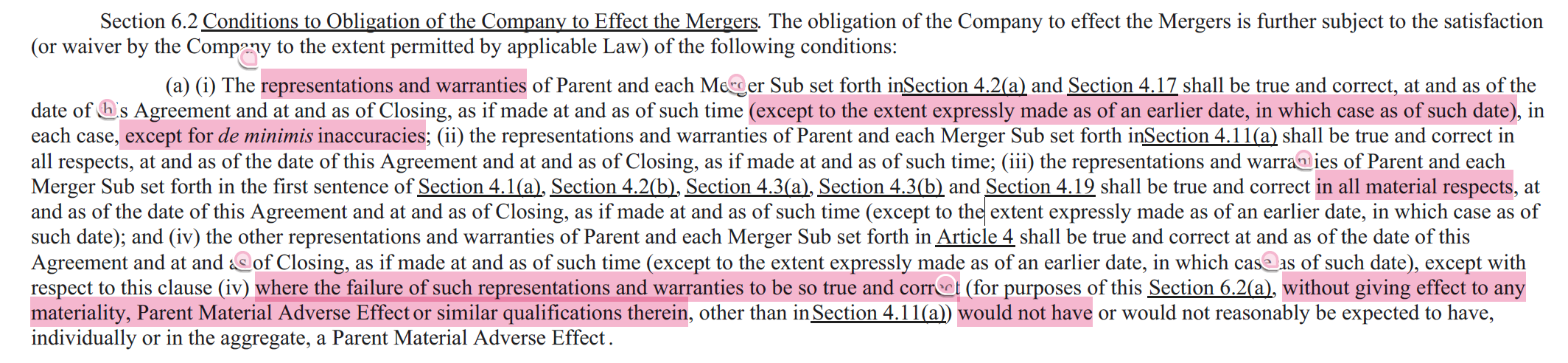
My comments in that section are limited to the bringdown condition. That part of a merger agreement generally has a lot going on. In the case of this one, it also happens to feature six instances of a mistake or a suboptimal choice. I’ll take this opportunity to touch briefly on three of those six. (To keep this short, I assume you’ve read that part of my analysis.)
Represents and Warrants
First, there’s my comment regarding represents and warrants. In it, I acknowledge that in M&A, the path of least resistance is to stick with represents and warrants. But I say that represents and warrants, and representations and warranties, make no sense.
I establish that much in my 27-page 2015 article Eliminating the Phrase Represents and Warrants from Contracts. In it I say, use instead states and statements of fact.
Reaching that conclusion wasn’t difficult. The conventional wisdom consists of two inconsistent rationales. I label them “the remedies rationale” and “the timeframe rationale.”
The remedies rationale suffers from these weaknesses:
- It seeks to apply to all kinds of contracts
- It seeks to override actual meaning
- It’s not supported by the law
- Semantically, it makes no sense
- It doesn’t explain current practice
My article cites arguments—inconsistent ones—by Tina Stark and Bryan Garner in favor of the remedies rationale, then refutes them.
And the timeframe rationale suffers from these weaknesses:
- It seeks to apply to all kinds of contracts
- It’s not supported by the law
- Semantically, it makes no sense
Game over, case closed.
Material Is Ambiguous
In my 2023 article The Word Material Is Ambiguous, Why That’s a Problem, and How to Fix It, I demonstrate that the word material is indeed ambiguous.
That’s something I’ve said for almost 20 years. But in 2018, in its opinion in Akorn, the Delaware Court of Chancery held that material adverse effect expresses a greater level of importance than does in all material respects, which “seeks to exclude small, de minimis, and nitpicky issues.” In so saying, the court in effect acknowledged that material is ambiguous. That gave me an excuse to revisit, in my 2023 article, the ambiguity of material and put the court’s holding in a broader context.
The Norfolk Southern merger agreement allowed me to revisit the issue yet again. One condition in that bringdown condition uses as a carveout “except for de minimis inaccuracies.” Another uses as the standard “in all material respects.” That suggests the drafter contemplated that a de minimis carveout and in all material respects express different standards, with in all material respects presumably expressing a higher standard.
That’s inconsistent with the Akorn court’s holding regarding in all material respects, but it shouldn’t come as a surprise to have the ambiguity of material infect a phrase that includes the word material. Go here for my blog post about this.
Double Materiality
The Norfolk Southern merger agreement includes a carveout to eliminate double materiality.
In M&A commentary, it’s accepted that qualifying both statements of fact and the bringdown condition by materiality results in double materiality. Yes, it does, but in the same way as my having two showers in one day results in double showering.
What are the implications of my having two showers in one day? There are none, other than the simple fact that it happens. The same goes for double materiality: it exists, but it has no repercussions. If a statement of fact and the bringdown condition are both qualified by materiality, they both look to the same external standard, which is a function of the effect on the buyer. They don’t reflect one standard building on the other. For more, see this blog post.
On Being Ignored
What unites my position on these three issues, besides their violating the conventional wisdom, is that no one has had a word to say about them.
That’s generally the case with my writings. In this 2020 blog post, I say, “[I]t’s exceedingly rare for anyone to take me on in the marketplace of ideas or explore my ideas in any detail.” I offer four reasons for that. Boiled down, they are:
- If you really want to critique my work, you’ll have some work to do. Few people can be bothered with that sort of thing or have the aptitude for it.
- There’s not much to be gained in arguing with someone who’s right. (In other words, me.)
- If you critique my work, I’ll respond, doing my best to be polite and constructive, but you might not want to have that sort of exchange.
- Those who are invested in a dysfunctional system have nothing to gain from challenging it and are temperamentally ill-equipped to do so.
I’m not suggesting there’s a grand conspiracy to ignore me. Instead, mainstream contract drafting has been enfeebled by cognitive debt, the result of endless copy-and-pasting. One consequence is that the associated scholarship and commentary is, with some notable exceptions, also feeble.
So I expect nothing from scholarship and commentary, and I won’t expect mainstream contract drafting to have a change of heart. Instead, I’ll continue working to make drafters aware of my take on these and other issues. For example, I’ve already had people tell me that they’ve used states and it wasn’t a big deal; see this 2022 blog post. And here from EDGAR is a recent example of use of states in a statement of fact by a party:
Employee states that Employee knows of no violation of state, federal, or municipal law or regulation by any of the Company’s Released Parties, and knows of no ongoing or pending investigation, charge, or complaint by any agency charged with enforcement of state, federal, or municipal law or regulation.
Eliminating represents and warrants allows you to rid your contracts of a source of confusion and legalistic nonsense.
It’s also easy enough to gain control over the ambiguous material: If you mean nontrivial, say nontrivial. If you mean dealbreaker, deploy a suitable definition of Material Adverse Effect.
Follow my recommendations and use them to your advantage.