
Recently I saw this LinkedIn post by Jerry Levine in which he outlines six different styles of contract.
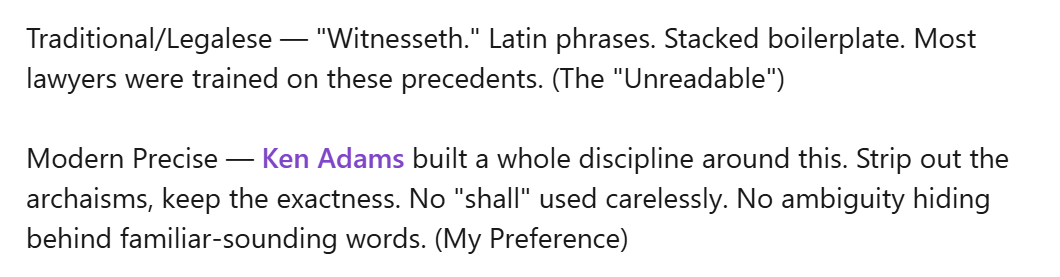
The accompanying image is of how his post describes the first two kinds of contract, namely “Traditional/Legalese” and “Modern Precise.” He tags me in “Modern Precise,” saying I “built a whole discipline around this.”
Jerry’s post got me thinking. In effect, he styles my work not as a gloss on traditional drafting, but as something distinct and apart. I hadn’t thought of it in those terms, but I think he’s right—my work reflects a methodical and rigorous approach that’s the opposite of traditional drafting. And I love the name “Modern Precise.”
I couldn’t help but notice that I’m the only individual associated with one of the six styles of contract. That reflects the scope of my work and the ambition of A Manual of Style for Contract Drafting. Without MSCD, there would be no Modern Precise.
For comparison, what are the hallmarks of Traditional/Legalese? Copy-and-pasting, obviously, and the cognitive debt that comes with it, so you’re cranking the handle of the copy-and-paste machine with little understanding to show for it. It’s a hermetically sealed world in which MSCD has never existed.
But Traditional/Legalese is the order of the day. It’s easy to identify its artifacts and those organizations that indulge in it. For an example, check out my new article in Corporate Counsel Now. (Go here for the article; go here for my related blog post.)
By contrast, the Modern Precise constituency is a diffuse one. MSCD has sold tens of thousands of copies; I’ve offered training to many thousands of participants; and people let me know my work is meaningful (see this blog post). But you’d be hard-pressed to see a Modern Precise contract in the wild (unless you drafted it) or identify a company or law firm that is avowedly Modern Precise. For example, I’ve idly considered the phrase The parties are signing this agreement (recommended in MSCD for the concluding clause) to be an MSCD-reader shibboleth. It’s on EDGAR, but in paltry numbers.
That’s because the constituency for Modern Precise is individuals, not organizations. That has to change if we want Modern Precise to play a broader role than being wielded by individuals at the margins of Traditional/Legalese.