
As I mentioned in this blog post, I’ve been leafing through some textbooks intended for teaching contract drafting. One of them is Tina L. Stark & Monica L. Llorente, Drafting Contracts: How and Why Lawyers Do What They Do (3d ed 2024). I happened to notice two technical mistakes in that textbook relating to principles of English usage. I thought it might be helpful for me to point them out.
One Mistake
This first relates to an example on page 375. It’s in this screenshot:
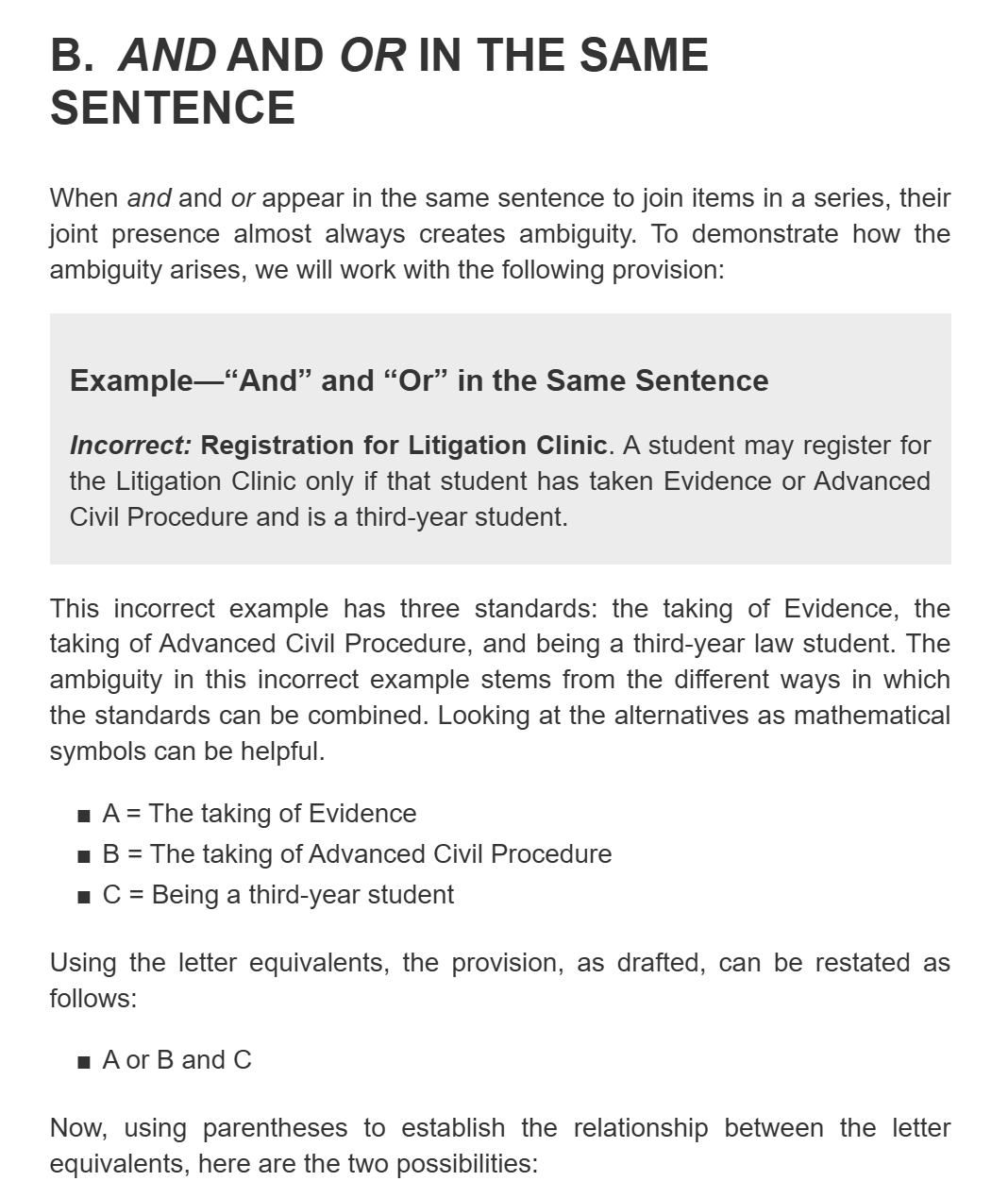
This example has been in the book since the 2007 first edition. It’s in chapter on ambiguity, and this example is meant to be ambiguous. But it isn’t ambiguous—it expresses only one meaning.
In that sentence, Evidence or Advanced Civil Procedure is a coordinated noun phrase functioning as a single direct object. It follows that Advanced Civil Procedure by itself isn’t available to act as the first coordinate in an and-coordination with is a third-year student.
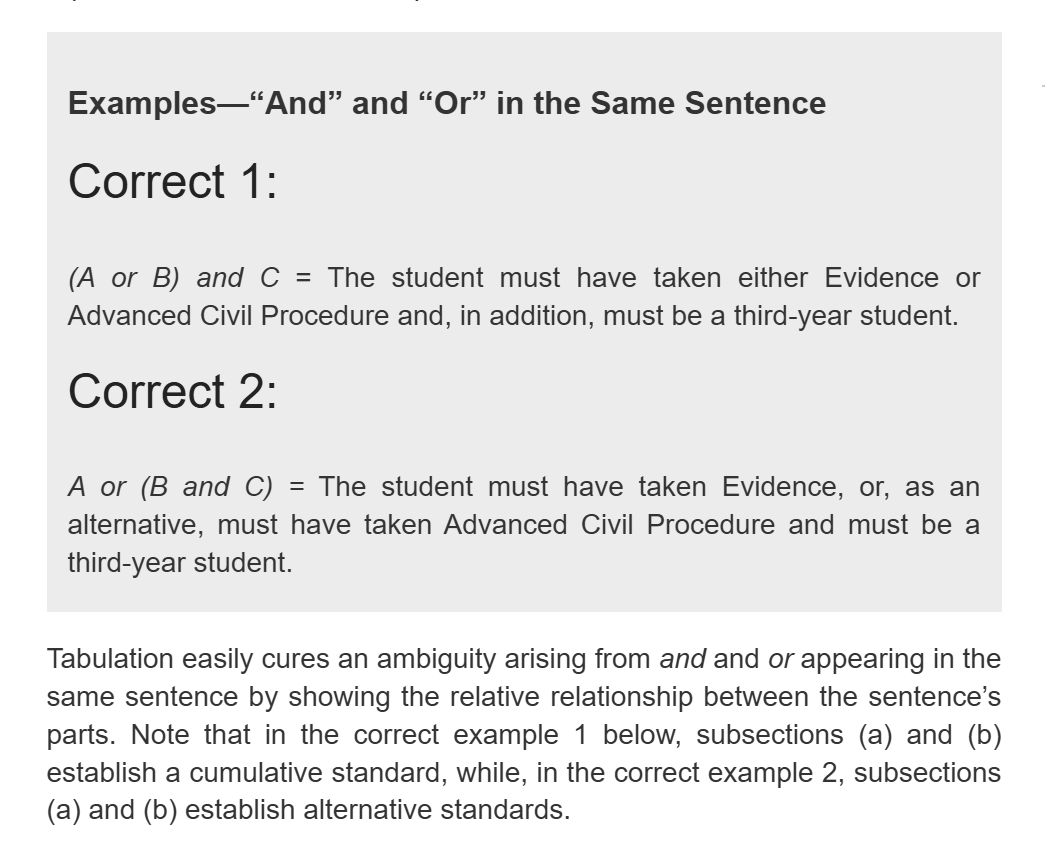
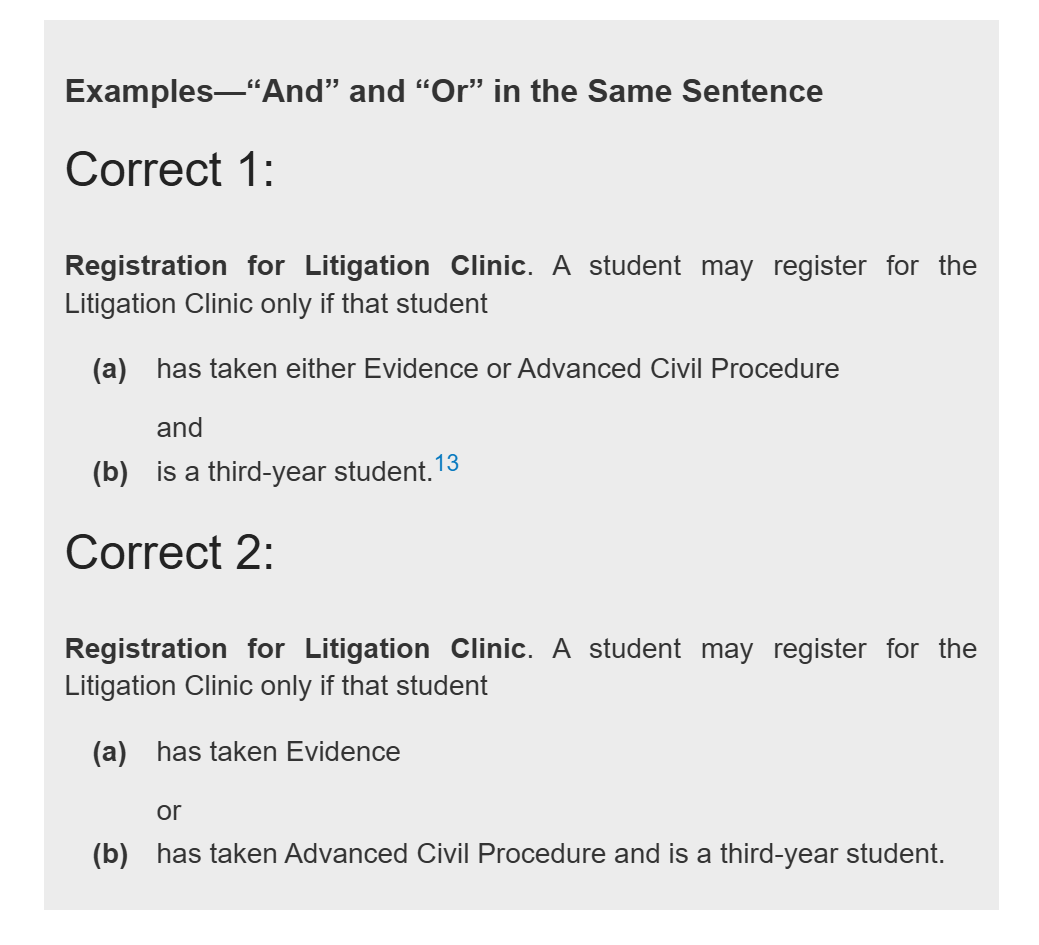
For Advanced Civil Procedure to serve that function, has taken would have to be used a second time, so it governs just Advanced Civil Procedure. In other words, the second half of the sentence would have to read as follows: only if that student has taken Evidence or has taken Advanced Civil Procedure and is a third-year student. One indication of that is how if you revise that sentence so or has scope over and (to use the linguistics terminology), you have to use has taken twice. You see that in each “Correct 2” example in the two shaded boxes below.
While I’m at it, here are some observations regarding the alternatives offered in in the two shaded boxes below:
In “Correct 1” in the first shaded box below, either on its own is sufficient to mark the beginning of the first coordinate in an or-coordination, so in addition is redundant. It would be better to omit it.
Regarding “Correct 2” in the first shaded box below, another way to express that meaning would be to say only if that student has taken Evidence or Advanced Civil Procedure, on the one hand, and is a third-year student, on the other hand.
Regarding the second shaded box below, tabulation isn’t essential. Enumeration can be tabulated or integrated (with the sentence stated in a single block of text). Integrated enumeration would be sufficient to eliminate the or … and ambiguity.
And in “Correct 1” in the second shaded box, either isn’t necessary to eliminate the or … and ambiguity, so it would be better to omit it.
You might have figured out from what I say above that this kind of ambiguity requires serious thought. I address it in A Manual of Style for Contract Drafting, in chapter 11, the chapter that deals with ambiguity caused by plural nouns and the words and, or, every, each, all, and any. My blanket term for that kind of ambiguity is “ambiguity of the part versus the whole.”
The 31 pages of that chapter constitute the only detailed discussion, in any literature, of ambiguity of the part versus the whole. For what it’s worth, that chapter was cited in a 2024 opinion by the U.S. Supreme Court (see this blog post).
I’ve made mistakes of my own in analyzing ambiguity of the part versus the whole, but I managed to fix them by burying myself in the subject and by getting help from a giant of linguistics, Rodney Huddleston, co-author of The Cambridge Grammar of the English Language. I’ve written in this 2020 blog post and this 2016 blog post about how I benefited from Rodney’s generous help.
Another Mistake
The other mistake occurs in an exercise at the end of chapter 8 that’s new to the third edition. It’s in this screenshot:
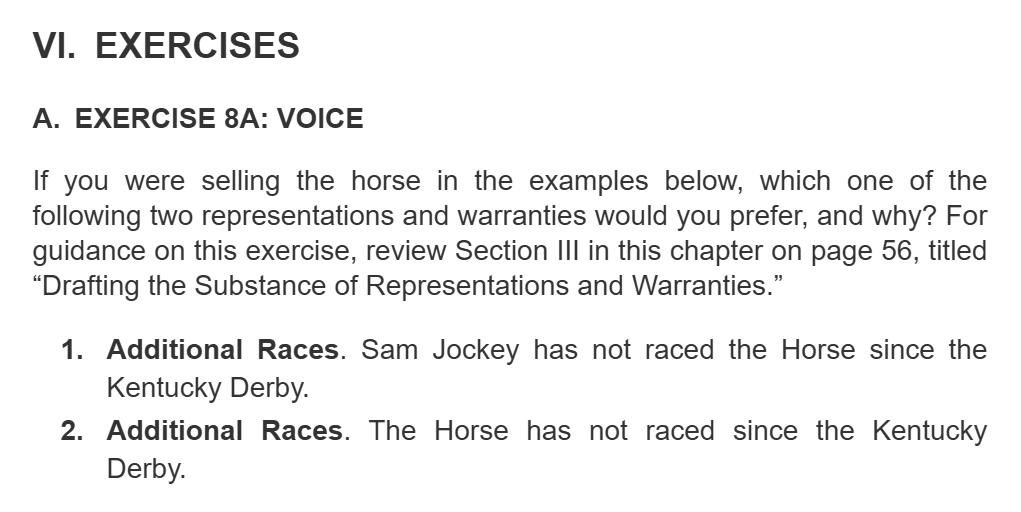
The heading suggests that this example is intended to address use of the active voice and the passive voice, a subject covered earlier in chapter 8. But what distinguishes these two sentences has nothing to do with that. The first uses raced as a transitive verb—it must have a direct object (in this case, the Horse). The second uses raced as an intransitive verb—it doesn’t take a direct object.
Both sentences are in the active voice. The first sentence could be expressed in the passive voice, but the second sentence cannot: Because intransitive verbs don’t take a direct object, they cannot be expressed using the passive voice.
The problem with the exercise lies with how the discussion earlier in the chapter is positioned. It makes the point that a statement of fact could be limited so it pertains only to a party, or it could be expressed more broadly. That discussion says that that distinction is a function of whether you use the active or passive voice, but the sentences in this example show that it isn’t so limited.